Overview
DESIGNED AROUND THE OBSTACLE
Our Barcelona balcony had an external air conditioning unit bolted to the wall, sitting on the floor, taking up a third of the usable space. Every solution I looked at treated it as something to hide — a box to put around it, a curtain to hang in front of it.
That framing was wrong. The unit couldn't be moved. It needed clear airflow on all sides to function. So I stopped trying to conceal it and started designing with it — using it as the structural anchor point the bench would be built around.
The result is a bench that sits directly over the unit. Vertical slats in the backrest allow rear airflow. Open sides keep the front and bottom clear. The unit runs exactly as it did before. The balcony gained a seat, a shelf, and the feeling of a space that was actually designed.
"The constraint wasn't the problem. The constraint was the brief."
2W
Build time
start to finish
€0
Material cost
fully reclaimed pallets
1:10
Scale model built
before any full-size cut
5
Design phases
ideation through result
Inspiration
STARTING WITH WHAT WORKS
Before picking up a pencil, I looked at two parallel references: pallet wood furniture for its material language and construction logic, and AC unit enclosures for the constraint they solve. Neither was quite right on its own — the furniture references ignored the airflow problem, the enclosures ignored the human use.
The gap between them was the design space. A piece of furniture that happens to function as a technical enclosure — not the other way around.


Ideation
SKETCHING IN CONTEXT
Early ideation was done in two modes simultaneously: freehand sketches to explore the form vocabulary quickly, and Autodesk Sketchbook overlays directly on photographs of the space. The photo overlays were more useful — they kept the constraints physical and visible rather than abstract.
Sketching over the actual balcony made it immediately obvious when a proportional idea was wrong for the space. Configurations that looked fine on paper were clearly too bulky, too narrow, or too tall when placed in context. Most ideas were eliminated within minutes of being drawn.


Prototyping
FULL-SIZE FIRST, THEN SCALE DOWN
Rather than committing to dimensions on paper, I used the pallet wood itself to prototype at full scale directly in the space. Loose boards were stacked and positioned — no fasteners, no cutting — just getting a sense of mass, seat height, and how different configurations felt to sit on and move around.
The immediate finding was that the first instinct — a larger, more generous bench — consumed too much of the balcony. The space was only useful if it stayed open. The prototype made that obvious in a way no sketch could. We wanted to be on the balcony, not just in it.


Refinement
SCALE MODEL BEFORE FULL BUILD
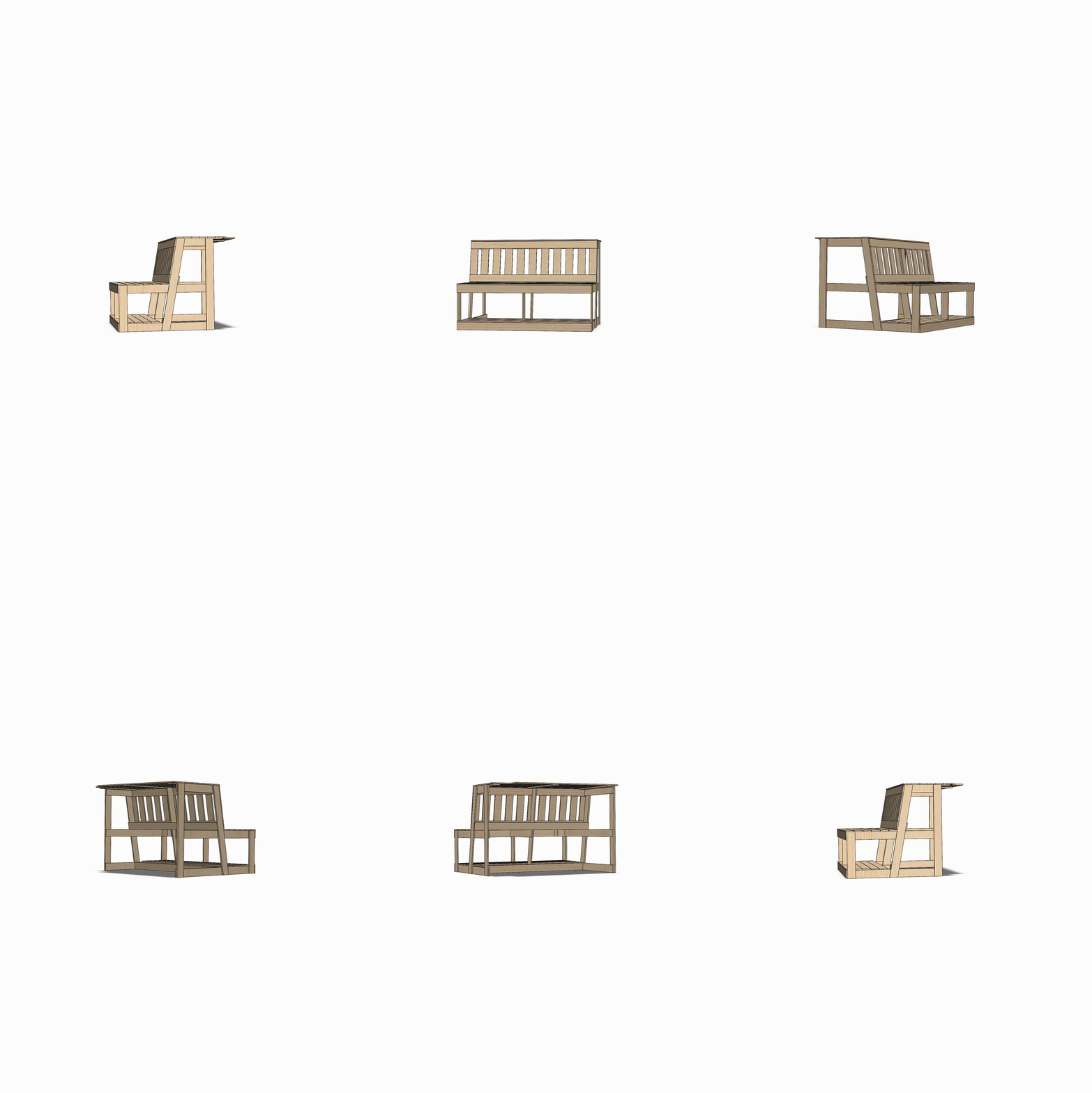
Once the configuration was locked — a compact bench sitting over the unit, with a backrest rising behind it and a shelf running along the top — I built a 1:10 scale model from lollipop sticks. The sticks were an almost exact scaled match to the pallet timber in cross-section, which made the model genuinely useful for working out joint details and assembly sequence rather than just visualising the form.
In parallel, I modelled the bench in SolidWorks. The CAD model served a specific purpose: generating the cut list. Every piece was named, numbered, and dimensioned. The goal was to arrive at the build phase with a single sheet of numbers and no ambiguity about what needed to be cut.


Planning
CUT ONCE
The SolidWorks model and scale prototype together produced a complete cut list — every piece of wood named and numbered before the first board was touched. The naming system carried through from CAD to physical timber: each piece was marked with its number before cutting so the assembly sequence was unambiguous.
The planning phase existed to make the build phase boring in the best sense — no decisions left to make on the floor, no re-cuts, no surprises. The only job left was execution.


Build
MAKING IT PHYSICAL
Pallet wood is unforgiving material. It's rough, inconsistent, and full of nails — but it has a grain and warmth that processed timber doesn't. Each board was stripped down, cleared of fasteners, and planed to a consistent face before cutting to dimension.
Assembly followed the cut list exactly. The underframe went together first to establish the footprint and height. The seat boards followed, then the backrest uprights and slats. Fitting around the AC unit required precise positioning — the frame had to clear the unit on all sides while remaining rigid enough to be structural.
The finished piece was sanded, treated for outdoor use, and fitted with cushions. Total material cost was zero — every piece of wood came from pallets sourced for free.


Result
THE BEST SEAT ON THE BALCONY
The bench works. The air conditioner works. The backrest slats allow full rear airflow; the open underframe keeps the sides and bottom clear. The unit is invisible from the seating position — present but not intrusive.
The balcony went from a space dominated by mechanical infrastructure to one that felt considered. The shelf running along the top became a planting surface. The seat became the reason to go outside.
The Blender render at the top of this page was made after the build — a retroactive visualisation of what had already been built, rendered and upscaled in Krea to match the quality of the physical result.


